Just as the world never was the same after 9/11 so it will never be the same after COVID-19 – and yet, it also won’t be the radical change many pundits are predicting.
Nearly 90% of all children are out of school – something probably never witnessed since the advent of mass schooling. And this is before we see whether the impact of the virus on African and South Asian countries is as dramatic as on Europe and the USA.
Most attention is focused – rightly – on the immediate and short term. How to keep children engaged, learning and positive in such circumstances. Many who live and work in developing countries point to the need to work hard to prevent disadvantage to poorer, more remote children – those without access to electricity, let alone digital alternatives to face-to-face schooling – see for example UNICEF’s Agenda for Action. Equally, we know that without specific intervention and thought, girls and those living with disabilities are likely to be disproportionately disadvantaged in these circumstances e.g. Werner and Skidmore on Liberia and Sierra Leone.
But, although it is right to focus on the short term education policy makers and planners will need to think through the scenarios that will operate when the peak has been passed and pressure mounts to open schools again. To assess the best, or even second best, options, more information and evidence of what has worked in other similar circumstances is needed – see Pauline Rose’s article for a good summary.
The litmus test of when countries are through the worst of the crisis may well be the reopening of schools. This was certainly the case in Sierra Leone after Ebola and led to the development of a comprehensive plan based on the application of a Safe Schools Protocol, extensive training for teachers and comprehensive hygiene measures and equipment provided to schools.
COVID-19 presents a similar but different challenge. Due to the asymptomatic nature of the incubation, adopting a policy of zero cases – as was done with Ebola in Sierra Leone – may prove impossible (see this article by Ed David and Chris Berry, DFID Education Advisers in Sierra Leone during Ebola and this by Colin Bangay, current DFID Education Adviser). Without comprehensive testing education planners will be left with a dilemma – to reopen schools, but how ? China may offer a path to follow, but only if countries have the resources to implement comprehensive testing and re-testing at a school level.
Planners and officials may then need to manage a system which is only partially open, or which opens then isolates particular schools or clusters temporarily. And where opening depends on testing they will need to ensure this does not lead to a dual-track system based on location and / or money. It would be easy to imagine testing becoming an income-related option further deepening social divides.
Planners will also need to protect children and teachers (especially those in higher risk categories), they will need to plan for not just curricular but extra-curricular policies, they will need to have rapid reaction policies in place for further outbreaks and they will need to have set of tools and options to choose from.
It is not so much the plans that need to be the focus, as the planning. Almost certainly there will be no break between the current crisis and the end. There will be no truce and armistice as in a war, only phony truces and armistices, partial openings and closings, steps forwards followed by steps backwards. In these circumstances, what matters will be the process of having planned out different scenarios that allow for flexibility and the unexpected, not the plans themselves. As Dwight Eisenhower, the former US President, once said : “In preparing for battle I have always found that plans are useless, but planning is indispensable.”
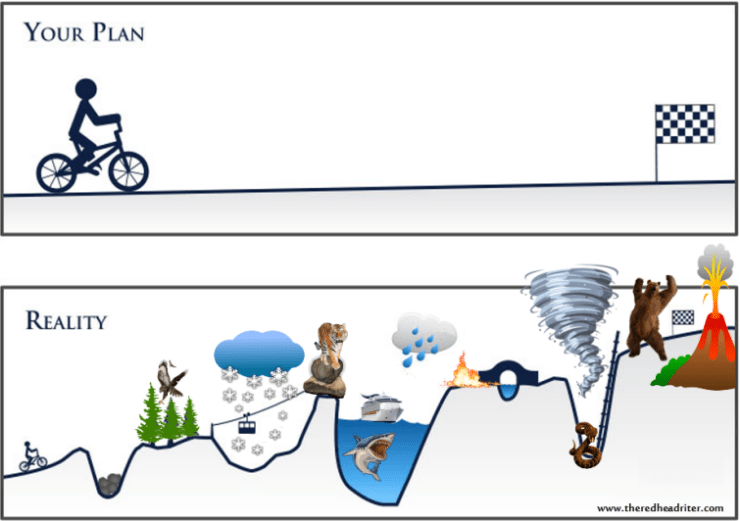
So, planning is essential to our new futures. With so much attention on the here and now – keeping the wheels on the bus as it swerves wildly along the road, it is difficult to lift our eyes to the future – to imagine the post COVID-19 education world. And yet, our way of living and coping now depends on how we imagine the future.
If we imagine the future as a return to “normality”, then just sit back and ride out the storm. If we imagine it as a dystopian vision where everything has changed out of all recognition, then hibernate and prepare for the worst.
But, if we imagine it as a future we can define, where some things have changed unalterably and others will go back to what they were before – a future which can be made better than the past – then we have to plan, build scenarios and be ready to throw those useless plans away – the better to plan again and build new scenarios. How widely we engage and consult in that process will determine how flexible we are.
It is through the action of planning and strategising, thinking and innovating, that we will shape the future as we go.
Andy Brock (all opinions my own)
 Brocksblog